



Living on the Enemy's Land: Wrestling with Utopia
INTERVIEW with director Thaïs di MarcoLiving on the Enemy's Land: Wrestling with Utopia
INTERVIEW with director Thaïs di MarcoLiving on the Enemy's Land: Wrestling with Utopia. INTERVIEW with director Thaïs di Marco
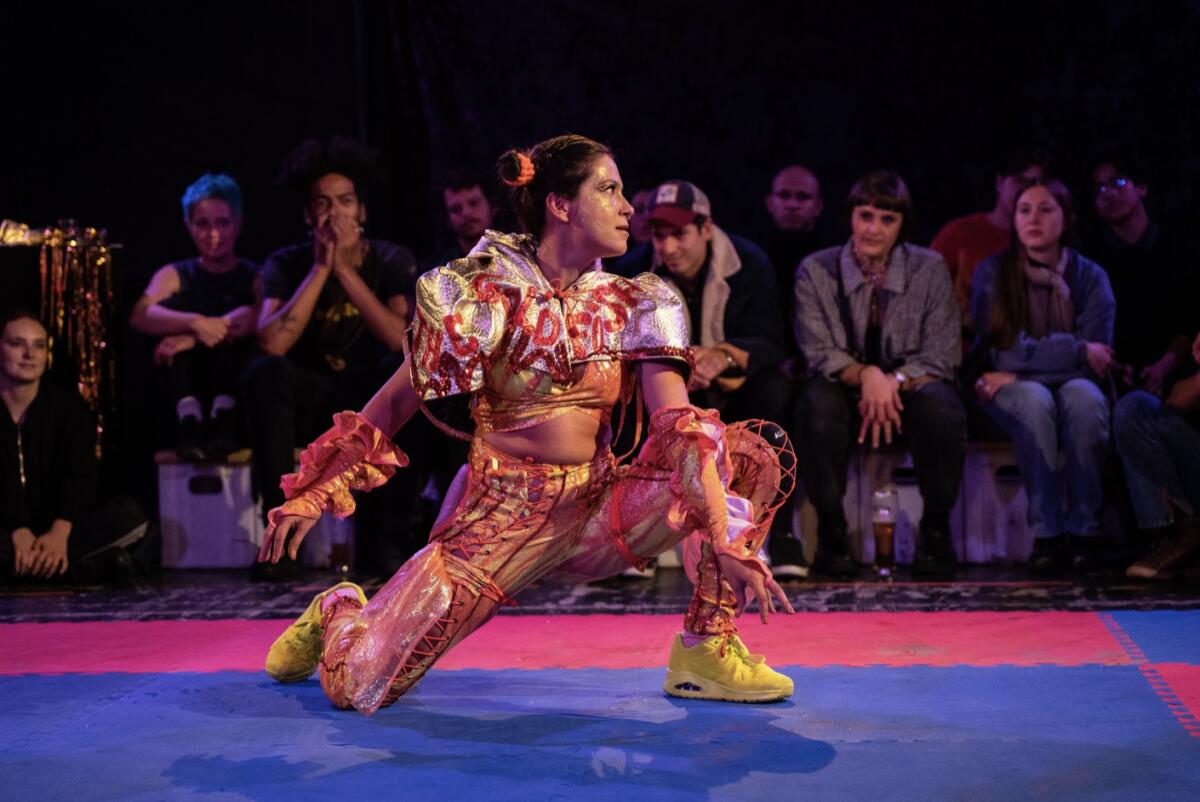
"Each year, we try to expose the conflicts that feel most urgent. "
Thaïs di Marco
Premieres on Friday the 18th and Saturday the 19th of September at CC Amstel
Since 2021, The Goldfish Bleeding in a Sea of Sharks has been turning real-world conflicts into full-blown Lucha Libre matches.
This year's edition, Living on the Enemy's Land, borrows its title from Brazilian rapper KL Jay and takes aim at what Thais Di Marco calls today's "techno-feudalists."
It's the latest chapter in a four-year residency at CC Amstel, using the wrestling ring as a stage where grief, satire, and rebellion can all throw punches at once.
Below, director Thais Di Marco, talks about falling in love with Lucha Libre as a kid, training with a wrestling master in Mexico City years later, why the ring beats a conventional stage, and why this piece is built to keep evolving with the audience helping decide what gets fought over next.
Thais: I have loved Lucha Libre since I was a child; it was extremely popular in the 1990s. Years later, while researching postcolonialism, postcolonial aesthetics, and art-making in connection with social movements fighting for the permanence of all peoples and the planet, I encountered Lucha Libre again in Mexico City. I spent some months studying with El Gladiador, a great master from Escuela Arena México, and experiencing the everyday life of a popular show that happens every week.
I was also fascinated by the audience. People from different social classes and nationalities come together in the same arena, including people who would probably never go to the theatre. This, for me, is part of the beauty of popular traditions of performing arts.
One of the cosmological narratives around Lucha Libre connects it to Aztec fighting and the idea of self-sacrifice: the fighter makes their name through sacrifice. I became interested in how wrestlers re-enact stereotypes and archetypes of social conflicts.
In my own community, we understand the performer, or the shaman, if that's a possible cosmological translation, as the community's right to speak with the invisible and with their ancestors.
So I found in Lucha Libre a popular, democratic, and diverse dramaturgy through which conflicts that are present but often invisible can be manifested. Re-enacting situations of oppression through comedy is also an ancestral practice of oppressed peoples around the globe.
It creates a space for mourning and anger, but also for laughter. Through this collective catharsis, perhaps we can say something that has never been said before, think something that has never been thought, and endure the exercise of trying to see possibilities even where there seem to be none.
For me, Lucha Libre became an exercise of mourning and fabulating: an insistence that social conflicts contain possibilities once we recognise that they are there and are inescapable. This became the basis of Retelling Structures, the method through which I create my pieces.
Rather than saying that wrestling can do something conventional theatre or documentary cannot, I would say that I am searching for a truly popular and ancestral language of performing arts, and that I am committed to audiences, to going where the people go.
Every form has its own aesthetics for a reason; this is an ancient, traditional, and popular dramaturgical form through which conflicts can be exposed and dealt with.
The piece takes its title from a line by Brazilian rapper KLJAY about there being no utopia while living on your dominator's land. How did that phrase shape the structure of this year's edition, and why did it feel like the right anchor for 'Living on the Enemy's Land'?
First, it is important to say that KL Jay was part of Racionais MC's, the most legendary rap group from São Paulo, the city where I was born. Their lyrics politically shaped an entire generation, influencing people, social movements, and artistic movements. KL Jay is deeply important to me and to the people I grew up around, as well as, I believe, to São Paulo, Brazil, and beyond.
The idea of enemy land stayed with me because it appeared as a response to revolt - when someone was outraged by a structure or a system. In my interpretation, the phrase says: this is not strange; it is coherent with the history of this place, with its history of land occupation and domination.
Each year, we try to expose the conflicts that feel most urgent.
In 2026, we are living under a dominant global class of techno-feudalists called "The Claudalists" who have accumulated capital, power, and technology on a scale we have never seen before. As a consequence, the struggle for the liberation of peoples and the planet has become exponentially more disproportionate. Many of our existing forms of social and political organisation suddenly seem somewhat obsolete. I think this moment demands a recalculation: what political and social projects are possible in the face of this new form of global, and increasingly cosmic, domination?
In that sense, it is not absurd to say that we are all living on enemy land, because the entire planet has, in some way, become hyper-colonised. In the piece, for example, we portray the Red Pill movement not simply as people radicalised by the internet, but as a consequence of the technological revolution: they are, in themselves, the internet. Technology and history do not move backwards. We now have to deal with a robotics revolution that is already here and moving towards space, searching for other lands on which to reproduce what I see as the post-Christian re-enactment of the apocalypse of capitalism and white supremacy.
So the phrase reminds us that the territory where we live is colonised and does not belong to us, while at the same time we know that this planet is ours too. For me, Living on the Enemy's Land opens precisely this political and existential paradox that we are living through now.
This is designed to return yearly over four years at CC Amstel. How do you see the piece evolving as new 'matches' and villains get added — is there a long-term arc you're building toward, or does each edition respond to whatever's most urgent that year?
First of all, being able to develop the same piece through different editions over four years is the realisation of a dream, a huge opportunity, and a privilege. I am deeply grateful to Inge Koks for making this possible, to CC Amstel, and to everyone who has been part of The Goldfish Bleeding in a Sea of Sharks since 2021, including Jan Pierre Brands, Felizitas Stileke, and so many others. The project has already involved more than 50 artists in the Netherlands, with others now joining it.
I hope this continuity can also demonstrate to audiences, theatres, and funding bodies how important it is to give artistic work time to develop, deepen, and transform. I also hope funding bodies recognise this importance and democratise the distribution of resources, so that long-term development and continuity become possible for more artists. At the moment, this remains a privilege available to very few - and often the same few.
I don't have a predetermined four-year arc yet. In fact, what I would love is for this year's audience to help shape the next editions by suggesting the conflicts they find urgent and would like me to research for the following year. I want the platform itself to become increasingly participatory, accessible, and shared with its audience as co-authors.
Ultimately, I want people to take this space as their own: a platform where they can encounter stories and conflicts that are familiar to them, but see and hear them again in new ways and through new terms. And perhaps, through that, continue the exercise of enduring hope: sustaining the difficult practice of imagining other futures, possibilities, and alternatives that have not yet existed, or that exist now in invisible forms.